
Simpson County Deed Record Types
The County Clerk records deeds and every related land instrument for Simpson County. Deed type signals how an interest moved. The signed instrument, not the label, controls the legal effect. So search the index broadly. Catch affidavits, commissioner's deeds, plats, and releases that hold the chain together.
| Deed Type | What It Does | Common Use |
|---|---|---|
| General warranty deed | Conveys the described interest with broad covenants stated in the document | Ordinary arms-length transfer |
| Quitclaim deed | Conveys whatever interest the grantor has without promising clear title | Family or chain cleanup |
| Commissioner's deed | Records a court-authorized conveyance | Judicial sale or partition |
| Affidavit of descent | Supplies facts about succession after death | Estate-related chain evidence |
| Plat | Records a mapped lot-and-block framework | Subdivision and boundary reference |
A mortgage or lien is an encumbrance, a recorded claim against the land. It conveys nothing to a new owner. Always pair the original filing with any later release or satisfaction.
Simpson County Clerk Recording Desk
The Simpson County Clerk is Austin L. Johnson. The recording desk sits at 105 East Kentucky Street in Franklin and keeps weekday hours from 8 a.m. to 4 p.m. Callers can reach the office at 270-586-8161, and mail goes to PO Box 268, Franklin, KY 42135-0268. For land-record links and office requests, the Clerk's own site is the best place to start.
The Clerk records page lists eCCLIX, DOC ALERT, e-recording vendors, and open-records resources.
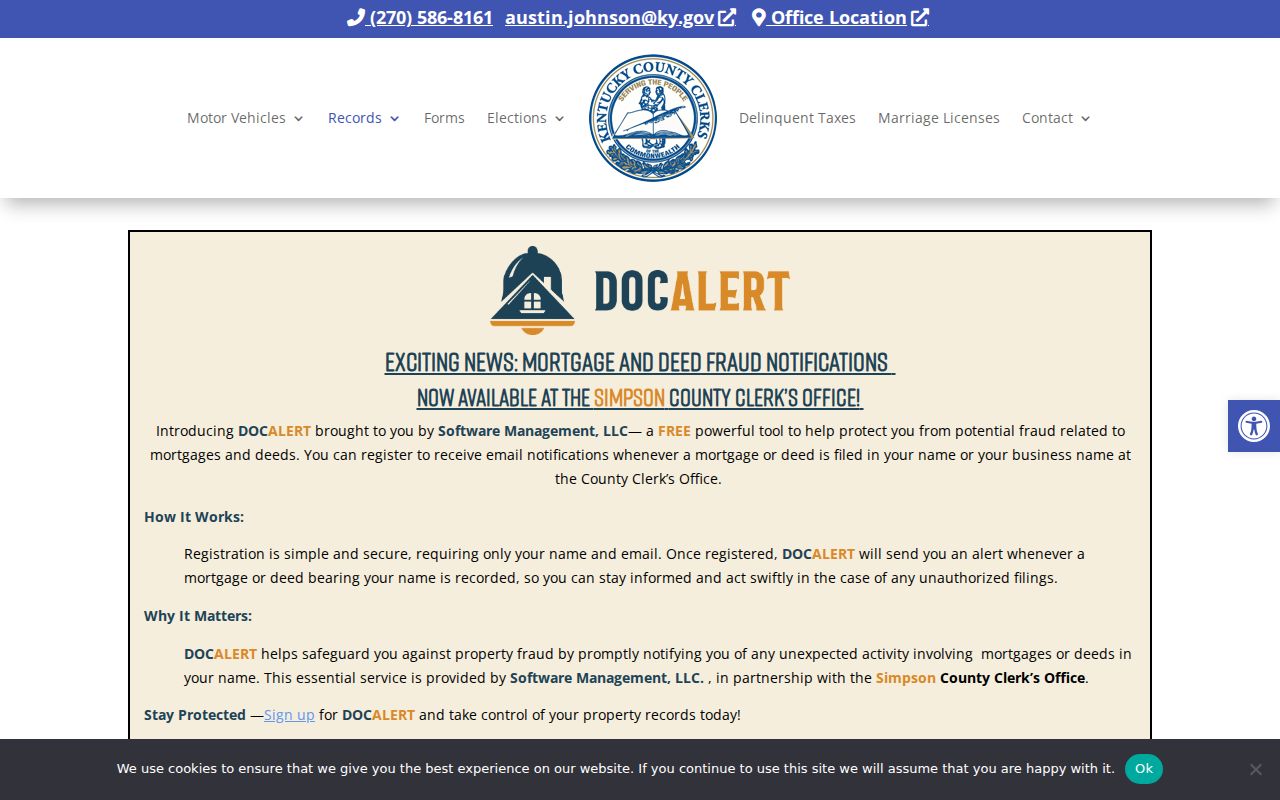
Use that page to enter the official access path. The listed e-recording firms accept electronic filings from authorized users, so they are not extra public deed indexes.
eCCLIX Simpson Deed Access
The Clerk routes online land-record access through eCCLIX, a partner serving many Kentucky clerk offices. Public accounts are available. The vendor schedule lists a one-day setup charge for the first county, a separate 24-hour county charge, monthly setup and county charges, and extra-user fees. Prices can change. Confirm every cost before purchase. Simpson's online cutoff and its exact labels for grantor, grantee, date, document type, book/page, and instrument number carry no published description. If a needed field or image is missing, ask the Clerk to search at the counter or process a request. That request path covers what the index cannot.
Simpson Grantor-Grantee Chain
A grantor-grantee index connects parties, not addresses. Start from a party tied to the parcel. Then match each candidate to a legal description and recording reference, because one name can attach to several tracts and unrelated people often share a name.
- Find the newest acquisition deed with the current owner shown as grantee.
- Read the grantor, legal description, execution date, recording date, and prior reference.
- Search that grantor as an earlier grantee and match the same land description.
- Repeat until online coverage ends, then continue in deed books, microfilm, or archives.
- Grantor
- The party conveying an interest.
- Grantee
- The party receiving that interest.
- Chain of title
- The linked sequence of conveyances for the same land.
- Book/page or instrument number
- The retrieval reference assigned to a recorded filing.
Simpson Deed Index Fields
Simpson County publishes no map of its result screens. Use a capture checklist instead. Record the indexed party exactly, the role shown, instrument type, execution and recording dates, county, image status, and retrieval reference. On the image itself, compare the legal description, consideration if stated, notary, prior deed reference, and attached exhibits.
| Search detail | Verified status | Safe method |
|---|---|---|
| Party role | Exact portal label not observed | Ask whether the person is grantor or grantee |
| Document type | Local recorded categories confirmed | Read the selected instrument itself |
| Date range | Online cutoff not published | Widen dates, then ask the Clerk |
| Reference | Screen format not observed | Copy book/page or instrument number as shown |
Legal Descriptions in Simpson Deeds
The durable land key is the legal description. A subdivision parcel cites a plat, lot, and block. Rural land leans on metes-and-bounds calls, acreage, surveys, neighboring owners, roads, or a prior deed. A street address helps you find the parcel, but it can change and may never appear in an old index.
Compare the latest deed with any recorded plat and earlier reference. Tax parcel lines and zoning colors orient you. Neither is a survey. Franklin subdivision rules cover preliminary and final plat review, streets, drainage, and public improvements, while the recorded plat itself belongs in the County Clerk trail.
Simpson Mortgages and Releases
Mortgages, assignments, mechanic liens, state and federal tax liens, and certificates of delinquency can all touch the recorded land trail. Some debts are voluntary. Others arrive through liens and delinquency certificates. Search both ends of each debt. A release, satisfaction, assignment, or discharge changes what an old index line seems to say. Litigation can add a lis pendens, judgment, or commissioner's deed. Match the court case through the Simpson Circuit Court Clerk or CourtNet. Then return to the land index for anything recorded against the property. Court and recorder files complement each other.
Historic Simpson Deed Runs
KDLA's inventory of Simpson deed microfilm starts with 1819 through 1831. Selected years then run through 1892. Later film covers 1940 through 1949 and 1951 through 1971. The gaps matter. They show only that the inventory claims no continuous film run, not that a missing deed never existed.
Simpson County formed from Allen, Logan, and Warren land in 1819, and a Logan County cut-off followed in 1869. A deed older than the boundary may sit under a parent county. Keep the original place names, neighboring-owner calls, and description. Just shift county indexes as you go.
The Simpson Archives and Museum also holds deeds, wills, old court papers, tax records, maps, and family collections. Those sources fill in context. The recorded deed remains the conveyance evidence.
Simpson DOC ALERT Notices
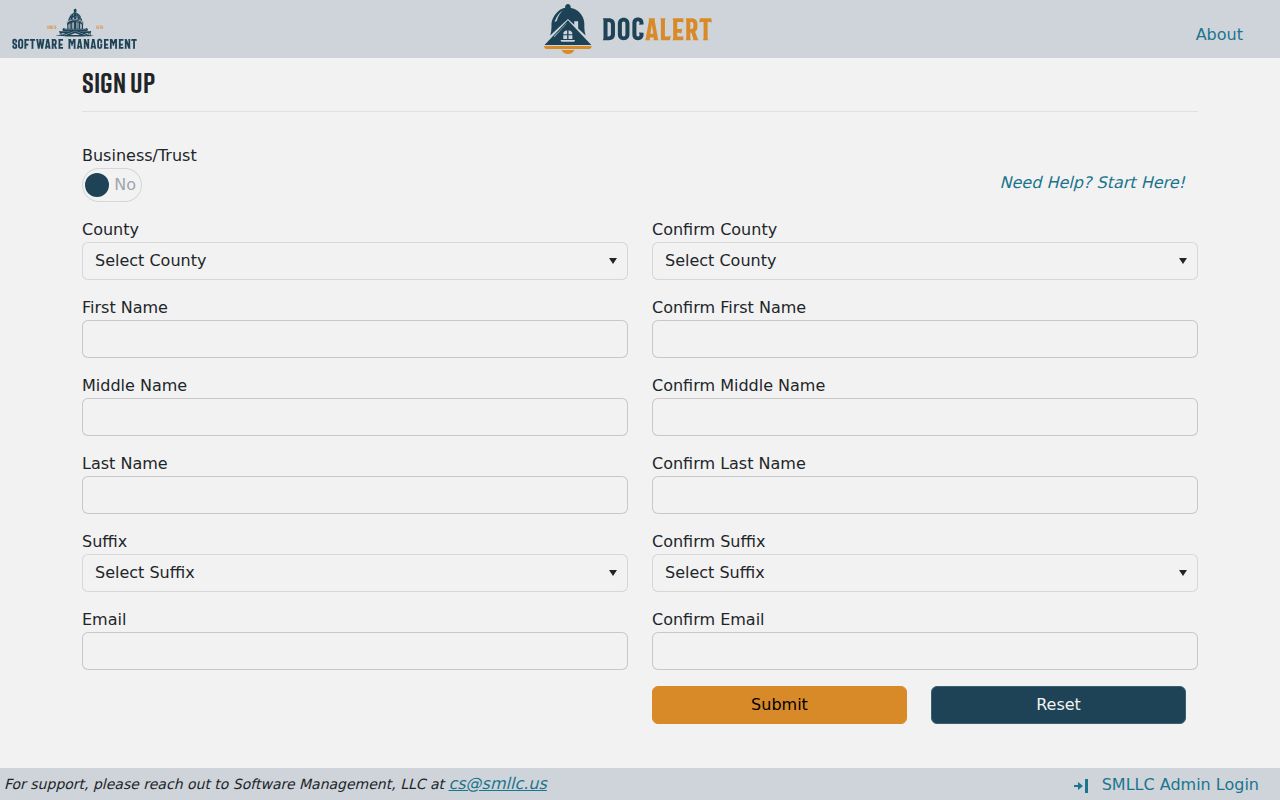
DOC ALERT is a free notification service tied to the County Clerk. Enrollment asks for more than the Clerk's brief description suggests. You pick the county. Then confirm your choice. Next, select a personal name or a business and trust entity. The form then repeats the name fields. It also asks you to confirm by email before the subscription takes effect.
The DOC ALERT form walks you through the registration flow.
An alert can flag a filing, but it cannot block one. It also will not replace title monitoring. If a notice surprises you, pull the underlying document and contact the Clerk through the official county contact information.
Order Simpson County Deed Copies
Check first whether your eCCLIX account already delivers the image. If it does not, give the Clerk a full party name and the instrument type. Include an approximate recording date and any book, page, or instrument reference you hold. Ask whether a plain copy suffices. Some receiving parties insist on certification. You can request copies at the counter or by mail. The Clerk's written open-records channels also work.
The county website still posts a page labeled 2020 Recording Fees. Current KRS 64.012 took effect July 15, 2026. It sets a $33 charge for many listed instruments up to five pages. Each added page costs $3. An added reference runs $4. Certified copies run $5, plus $0.50 per page beyond three pages. Where the older county schedule differs, confirm the current charge and instrument category with the Clerk.
Recorded, not guaranteed. Simpson County deed records show what reached the recorder. They do not rule out an unrecorded interest or provide a title opinion.
Resolve Gaps in Simpson County Deed Records
A missing online result does not prove a Simpson County deed went unrecorded. The eCCLIX index publishes no stated cutoff date. The KDLA microfilm inventory lists selected runs rather than seamless coverage. Begin with the most recent deed you trust. Copy its prior-instrument reference and full legal description. Then ask the Clerk which book, film, or stored series covers the earlier date you need.
Names can break a chain too. Search maiden and married styles, initials, suffixes, trusts, estates, fiduciaries, commissioners, and business entities. Kentucky deed guidance gives a warning. Heirs, commissioners, and sheriffs can appear in transfers that never look like an ordinary sale. A probate file, affidavit of descent, court order, commissioner's deed, or later corrective instrument may explain it. It shows how title passed between two familiar names.
Geography creates its own gaps. Simpson County formed in 1819 from Allen, Logan, and Warren Counties. A three-mile Logan County cut-off followed in 1869. An older description may sit in a parent county's index even though the land lies in modern Simpson County. Carry the exact metes-and-bounds calls, neighbors, roads, streams, acreage, lot, block, and plat references into that other index.
The 1882 courthouse disaster deserves caution, not speculation. The event is documented. No complete list of destroyed series exists. Check the surviving Clerk books, KDLA microfilm, tax books, probate material, and Simpson County Archives holdings. Do that before declaring any year lost. The archive's maps, newspapers, obituaries, and family files can restore context. The surviving recorded instrument remains the evidence for the conveyance.
Note: Keep both the direct and reverse index trail, since the same person may appear as grantee on acquisition and grantor on transfer.
Verify the final instrument reference with the Simpson County Clerk. Order or rely on a copy only after that check.