
Check the Simpson County Current Owner Record
Start with the certified Tax Roll kept by the Simpson County PVA. Its official page confirms that ownership information is available. The local Schneider parcel screen blocks some visitors. Copy only the fields shown on the live record or supplied directly by the PVA.
| Owner name | Tax-roll owner; exact local label must be verified |
|---|---|
| Mailing address | Tax correspondence destination, if displayed |
| Situs address | The parcel's physical location |
| Parcel/account | The exact cross-reference key; local format is unpublished |
| Sale or deed reference | Use only when the live card displays it |
| Assessment year | Dates the roll and its January 1 owner framework |
The owner of record is not always the person living there. A mailing address can differ from the situs address, so confirm the parcel number and land location before trusting a same-name match.
Measure Simpson County Owner Records From January 1
Kentucky keys assessment ownership to January 1. A deed recorded after that date can name a buyer while the current tax bill still shows the prior owner. Simpson's PVA tries to mail the bill to the new owner using deed information. No official source states an average update lag.
Owner of record: the name carried by whichever record you are consulting. Assessment roll: the PVA property list used for taxation. Recording lag: the time between a transfer and its appearance elsewhere.
Read the assessment year and the deed recording date together. A buyer listed "in care of" does not change the annual roll rule.
Inspect the Simpson County PVA Gateway
The county's official PVA page is shown below. Check the live PVA source for its certified Tax Roll route.
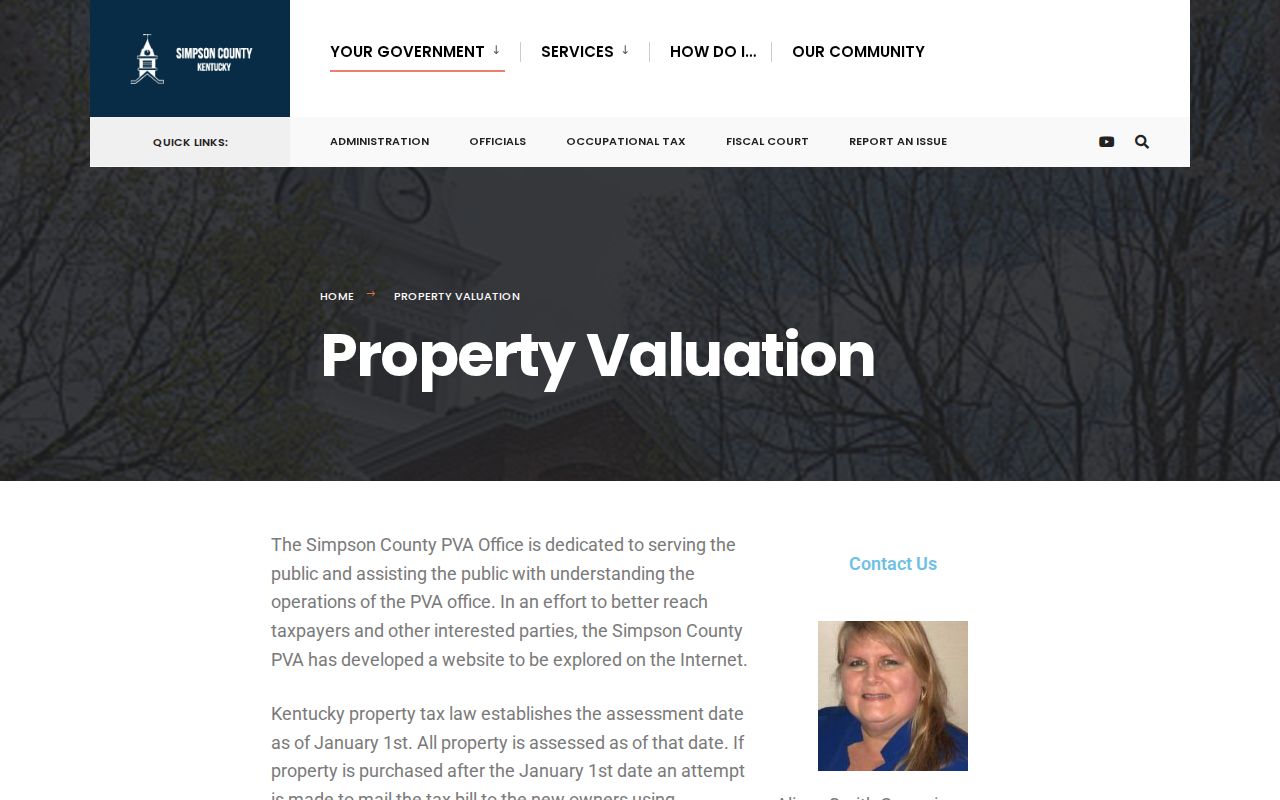
The page supports the ownership and January 1 explanation. It is not a parcel card, and it does not confirm specific result labels.
Interpret a Simpson County Entity Owner
An LLC, trust, estate, or joint ownership can make a roll name look unfamiliar. Preserve the wording exactly. A business grantee can be compared through the Kentucky Business Entity Search. Remember that a registered agent is a contact point, not proof of land ownership.
Trusts may appear under the trust name or the trustee. Estates often use "Estate of," executor, administrator, or fiduciary styles. A life estate, survivorship deed, affidavit of descent, quitclaim, or commissioner deed can define the current interest more precisely than the roll.
Confirm Who Owns Simpson County Property Now
The roll gives a fast present-tense lead. After a recent closing, the newest recorded conveyance is the stronger check. The County Clerk records page routes land research to eCCLIX.
- Read the PVA owner, situs, parcel number, and assessment year.
- Search that name as grantee in eCCLIX.
- Match the newest deed's legal description and parcel references.
- Ask the Clerk or PVA to resolve a mismatch.
- Owner of record
- The party named by the dated public record.
- Vesting
- How the deed states the interest is held.
- Registered agent
- An entity contact, not automatically the owner.
Resolve a Simpson County Owner With No Tax Bill
A buyer after January 1 can hold the newest deed yet never appear as the main current-year bill name. The PVA tells a new owner who receives no bill to contact the Simpson County Sheriff. Current bills sit with the Sheriff. Delinquent records later move to the Clerk.
Have the deed reference and parcel account ready. Confirm the mailing address, but keep billing workflow separate from title.
Note: For a recent sale, the newest matching recorded deed can be more current than the annual owner line.
Protect Simpson County Current Owner Information
Kentucky Safe at Home can substitute an address in public records. A displayed mailing address may be a protected routing address. It is not always evidence of residence. Use current owner records for lawful purchase, estate, tax, boundary, and civic work. Never use them to stalk, harass, intimidate, or harm anyone.
Match Simpson County Situs and Mailing Fields
The situs describes the physical parcel. The mailing line tells the county where to send notices. The two may match, but no rule requires it. An owner can use a post office box. A business office, fiduciary address, or another valid destination also works. That difference alone is not proof the owner record is wrong.
For a current owner decision, use the situs and parcel account. That establishes which land the card describes. Treat the mailing line only as a contact clue. The street address may have changed. A Franklin postal label may also cross the city line. In that case, rely on the deed's legal description and the parcel identity.
Use Simpson County Counter and Request Channels
A blocked web page is an access problem. It is not proof that the owner record is unavailable. Contact the PVA for the certified-roll entry. For the recorded conveyance, use eCCLIX, visit the County Clerk, or make a written request under the Kentucky Open Records Act.
KRS 61.880 sets the agency response or written-denial process at five working days. KRS 61.874 governs inspection, copies, and fees. Give the office a precise parcel, address, owner spelling, date range, and the record you want. Do not ask for an open-ended title search.
Distinguish the Simpson County Roll From the Deed
The assessment roll and the recorded deed are separate records serving separate purposes. The PVA values parcels for the tax roll at one annual snapshot. The County Clerk records instruments as they arrive for recording. So a name mismatch is often just timing. It can also signal other causes. A life estate, a trust, estate administration, or joint ownership can explain it. A deed tied to the wrong parcel can too.
Note each result's source, date, and exact owner spelling before comparing anything. Judge the legal land itself rather than forcing names to agree. A deed may carry an exception, multiple tracts, or a prior reference. Chase those details before trusting it as controlling the parcel. Recording proves acceptance, never a clean title opinion.
Check Simpson County Current Ownership After a Death
A deceased name on the tax roll tells you nothing certain about who now holds each interest. The ownership trail may run through a will. It may also run through a probate order, an affidavit of descent, a fiduciary deed, a survivorship clause, or a later conveyance. Simpson County wills and probate land papers often matter. Even so, the final answer rests on the recorded deed.
Search the decedent's full name plus the "Estate of" form. Add any executor or administrator, and any trustee. Dates deserve close comparison. KDLA lists Simpson will microfilm covering 1882 through 2002. Current files sit with the local court, and the Clerk record paths by record type. Never assume heirs from a shared surname.
Document a Simpson County Current Owner Finding
A solid research note captures the situs, the parcel or account identifier, the owner spelling, the assessment year, the date the roll was accessed, the newest matching deed date, its recording date, the grantee, the instrument reference, and any mismatch left unresolved. It also flags any field the local portal does not expose.
That discipline makes the finding repeatable. Another reader can revisit the same public property records and see why the latest deed outranked the roll, or why an entity filing served only to interpret a legal name. Keep copies within the office's terms. Verify again before any transaction.
For a high-stakes decision, rerun the current owner check close to the decision date itself. Record that date and pull the actual deed rather than trusting a transcribed name.
The PVA and Clerk fill different record roles. So cite both whenever timing or identity stays uncertain. Keep the parcel number central from start to finish.
Contact a Simpson County Current Owner Carefully
When the roll shows a mailing address, it is the official correspondence lead, but it does not prove where the owner of record actually lives. For a genuine purchase, boundary, access, or estate question, name the parcel neutrally in a written message. Respect any substitute address the owner supplies.
Lawful use. Public owner information supports property diligence, not surveillance. Repeated or threatening contact is prohibited.