
Find Out Who Owns a Simpson County Property
An owner search in Simpson County works best as a short trail. Start with the street address. Translate it into a tax-roll identity, then test the resulting name against the newest land record. The Simpson County Property Valuation Administrator confirms that its certified Tax Roll carries ownership information. The county's Schneider property search can be slow to load. So do not count on any particular on-screen label. Trust the card the office publishes.
- Enter the situs address in the Simpson qPublic/Schneider Tax Roll and copy the owner and parcel or account number exactly.
- Use the owner name in the County Clerk's eCCLIX land-record system and locate the newest recorded conveyance.
- Compare the grantee, legal description, parcel reference, and recording date with the PVA result.
- If an LLC, trust, or estate holds the property, search the exact legal-name variants in the related official records.
The payoff is reliability. A commercial address-only result cannot match a roll-plus-deed check, and the trail stays auditable whenever the tax roll and the deed records disagree.
Identify the Simpson County Property Owner on the PVA Roll
The PVA describes the Tax Roll as current and certified, listing ownership and property characteristics when available. Vendor software offers many search modes. Name, address, and parcel ID are typical. Local labels can differ. Treat the Simpson County parcel card as the source, and copy exactly what it prints.
| Item to capture | How it helps identify an owner | Local status |
|---|---|---|
| Owner name | Names the tax-roll owner | Advertised by PVA; label not visually verified |
| Situs address | Connects the physical place to the parcel | Exact card field not verified |
| Mailing address | Shows the tax correspondence destination | Exact card field not verified |
| Parcel/account number | Provides the strongest cross-reference key | Format not published |
A missing label is no invitation to guess. When the online property search will not load, call the PVA at 270-586-4261 and ask for the certified-roll entry tied to the address. The office channel works too.
Note: A mailing address can differ from the property address and does not show that the named owner occupies the parcel.
Trace a Simpson County Closing Past the January 1 Roll
In Kentucky, property assessment runs on January 1 ownership. A sale later in the year can leave the seller's name on the current tax bill. But a newer deed already names the buyer. The Simpson County PVA mails the bill to the new owner using recorded-deed information when it can. The state tax rule, though, still explains why the old roll name appears.
The controlling public record decides. On the tax roll that may mean the January 1 owner, while the newest deed's grantee reflects the recorded conveyance itself.
Situs and mailing addressThe situs locates the land. The mailing address routes notices and may be elsewhere.
Check both dates when timing matters. Match the deed's execution and recording details against the assessment year rather than treating either screen as timeless.
Confirm the Simpson County Owner in the Newest Deed
eCCLIX is the gateway. The Simpson County Clerk records page points land-record searchers there. Search the PVA name as a grantee. Then match the legal description, subdivision and lot, prior instrument reference, or parcel reference before concluding anything. A common name alone proves little. eCCLIX uses accounts and paid day or monthly access, though Simpson County's exact index cutoff and field labels go unpublished. The Clerk counter still works. So does a written request under the Kentucky Open Records Act.
The official PVA page documents Simpson County ownership and its January 1 framing, so view the live PVA source page before relying on any image.
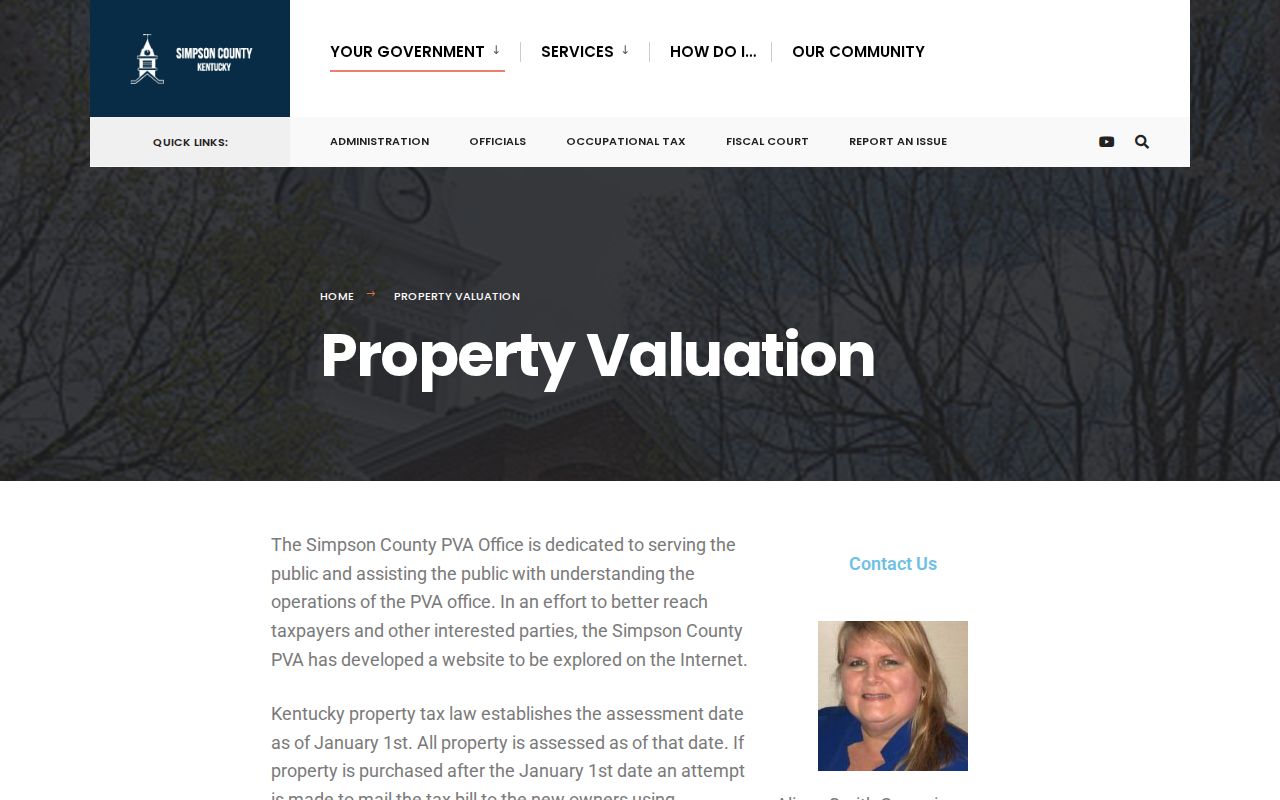
Treat the image as a gateway, not a parcel card. It points toward the certified Tax Roll while leaving the documented gaps around exact result fields.
Identify an LLC, Trust, or Estate Property Owner
A tax roll sometimes names an entity, not a person. Search the LLC name exactly as shown. The Kentucky Secretary of State Business Entity Search handles that lookup. Compare the result with the deed grantee. A registered agent is not automatically the landowner. Trusts can appear under the trust, the trustee, or both, and estates may use “Estate of,” executor, administrator, or fiduciary wording.
These variants matter after deaths and business transfers. A deed, probate instrument, affidavit of descent, or commissioner deed can explain a name the assessment roll compresses. Preserve the index punctuation, and verify the land description.
Compare Simpson County Property Ownership Sources
No one Simpson County source settles every ownership question. The tax roll names the owner of record fast. Deed records prove how title moved, one conveyance at a time. A GIS map adds place context, but only when its parcel layers match the county's own data. Use them together for a fuller answer.
| Where ownership appears | What it contributes | Access route |
|---|---|---|
| PVA certified Tax Roll | Advertised ownership information as of the assessment framework | Official-linked Schneider application or PVA office |
| County Clerk land records | Grantee and recorded conveyance details | eCCLIX, Clerk counter, or records request |
| Secretary of State | Legal business name and filed entity details | Free state entity search |
| Planning zoning map | Geographic and zoning context, not verified parcel ownership | Franklin-Simpson ArcGIS map |
Mail recipients, occupants, and the owner of record can be three different people. Solid Simpson County property owner research reports what the recorded document actually establishes, nothing more.
Follow Simpson County Deed Activity With DOC ALERT
The County Clerk offers a free fraud-monitoring service alongside its paid land-record partner. DOC ALERT takes a personal or business name, a county, and a confirmed email. It then watches for deed or mortgage filings indexed under that name in Simpson County. An alert settles nothing by itself. It cannot block a filing either. Think of it as a nudge to pull the instrument, call the Clerk, and get qualified help if the recording looks wrong. For an owner who wants notice without repeated eCCLIX searches, the name watch is a practical safeguard.
Use Simpson County Land Clues When Names Fail
A shared surname or a company styled three different ways invites false matches. Test identity with hard land clues instead. Check the subdivision lot and block, the metes-and-bounds description, and adjoining-owner calls. Add the prior deed reference and the exact parcel or account number. ZIP labels 42134 and 42135 in Franklin help mail arrive. They do not set city limits or settle title.
Older land needs a deeper path. The Simpson County Archives/Museum and the Kentucky Department for Libraries and Archives both hold historic material. KDLA confirms selected Simpson deed microfilm runs starting in 1819. A legal description sometimes cites a road name, parent-county reference, or subdivision that predates modern addressing. Those deed records usually close the gap.
Keep a Simpson County Ownership Evidence Note
Build a short evidence note whenever you trace ownership. Record the parcel or account number, the owner spelling exactly as shown, the assessment year, the deed recording date, the grantee, and how the legal description matched. Note which portal fields you could not confirm. A dated note like this keeps an ownership answer reproducible, and it stops a later reader from confusing the tax-roll date with the deed date.
Recheck the official records before any purchase or filing. Names change and instruments change. A copied commercial summary is no substitute for the dated trail itself.
Phone and counter answers deserve the same discipline. Write down the staff guidance you receive, then request the underlying record so the verbal answer leads back to a dated roll or instrument.
Know What a Simpson County Property Owner Lookup Cannot Prove
A public lookup has limits worth naming. It can identify the name carried by a tax roll or deed, nothing more. It cannot guarantee present title, possession, occupancy, boundary location, or authority to sell. Kentucky Safe at Home may substitute an address in public records for a participant, and restricted identifiers are never a legitimate target of an ownership search.
Ownership is not a title opinion. Use Simpson County owner records for lawful purchase, estate, boundary, and civic research. Never use them to stalk, harass, intimidate, or harm anyone.
High stakes call for a professional. When a purchase, lien priority, heirship, or disputed boundary is involved, have the relevant deed and instruments reviewed by someone qualified. A search result is only a starting point.