
Trace Back Simpson County Former Owners
The search starts at the newest deed. Work backward one transfer at a time, and the Simpson County Clerk records the deeds while routing online land-record access through eCCLIX. Deed books, Kentucky State Archives microfilm, tax books, and the local Archives/Museum hold the earliest names in the ownership chain.
| Transfer date | Grantor to grantee | Deed type | Reference |
|---|---|---|---|
| Newest first | Prior owner to current grantee | Warranty, quitclaim, commissioner, or other instrument | Instrument number or book/page |
| Next earlier | Earlier seller to that prior owner | Read from the indexed deed | Carry the prior reference backward |
| Historic era | Names in deed books and reverse indexes | As recorded | KDLA microfilm or Clerk volume |
The backward timeline guards against a common mistake. Searching a modern address across every year misses older instruments, which are tied together by party names, legal descriptions, and recording references instead.
Go Back Through Simpson County's eCCLIX Index
Begin by searching the present grantee. Open the most recent matching deed and read the grantor. Search that grantor as a grantee to find the deed that conveyed the land. Repeat while the legal description still matches.
eCCLIX offers paid day and monthly access. Simpson County publishes no earliest online year, field labels, or image rules. The cutoff stays unknown. The Clerk counter is the fallback for index and volume help.
The official page shows the land-record entry point. Open eCCLIX to check current access terms.
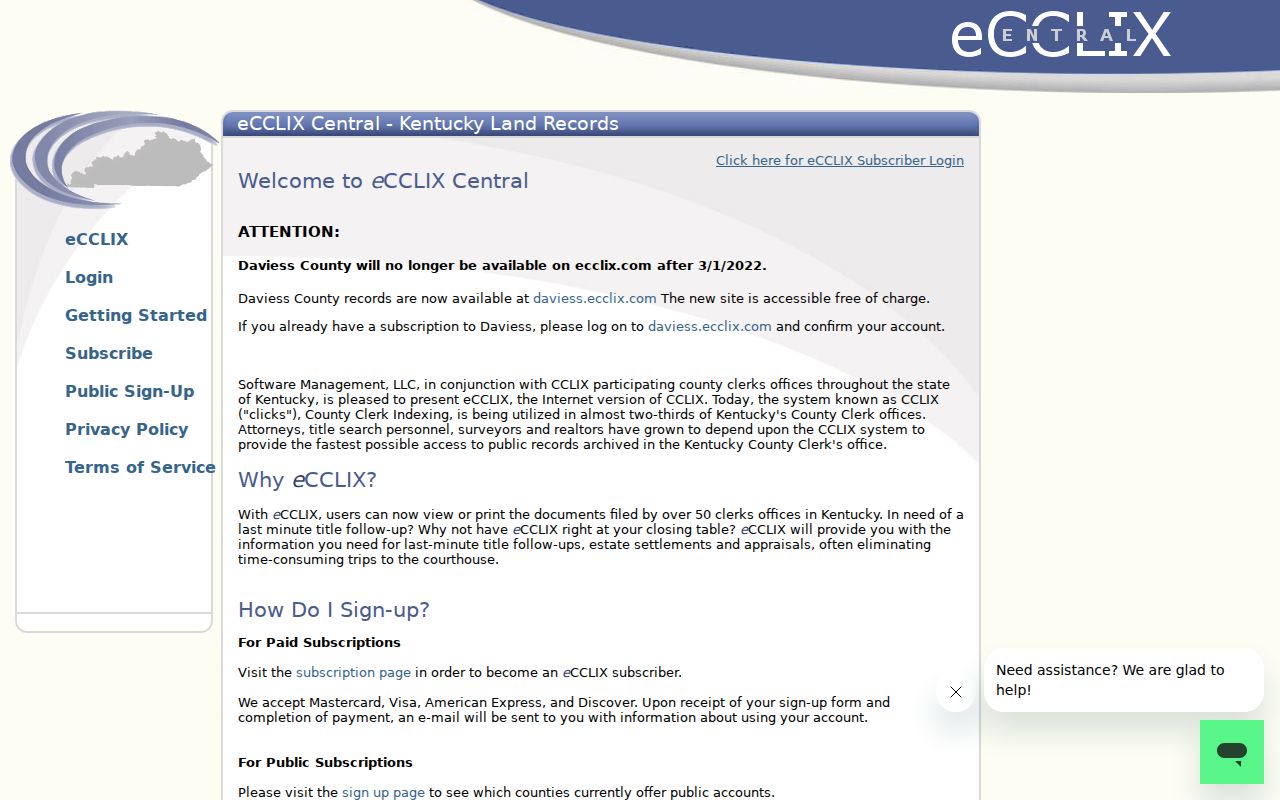
The image documents the partner platform. The chain itself still depends on indexed names and a matching land description.
Search H, C, and S for Simpson County Prior Owners
KDLA's deed guidance goes beyond buyer and seller. Historic indexes may file heirs under H, commissioners under C, and sheriffs under S. Estate, fiduciary, and trustee entries matter. Spelling variants can bridge what looks like a missing conveyance. Search both directions and preserve initials. Compare spouse names, adjoining owners, acreage, lot and block, metes-and-bounds calls, and prior instrument references. Do all of this before joining two deeds.
Recover Simpson County Deeds From 1819 Forward
The KDLA land-record inventory lists Simpson deed microfilm for 1819–1831, 1833, 1835, 1837–1875, 1879–1892, 1940–1949, and 1951–1971. It also shows tax assessment books from 1882–2003 and wills from 1882–2002. These are listed runs, not continuous survival. When eCCLIX stops, the County Clerk, KDLA's records-request service, and the Simpson County Archives/Museum form the access chain. Simpson was formed from Allen, Logan, and Warren counties. A pre-1819 trail may require Allen, Logan, or Warren.
Reconstruct Simpson County's Ownership Chain in Reverse
Record each link before moving earlier. The current deed is only the starting point, and its grantor and prior reference lead the next search.
- Find the newest deed with the current party as grantee.
- Record its grantor, date, deed type, legal description, and book/page or instrument number.
- Search that grantor as a grantee and verify the same land.
- Continue in reverse indexes, books, or microfilm when the online trail ends.
- Grantor / grantee
- The conveying party and receiving party.
- Chain of title
- The ordered series of instruments affecting the land.
- Reverse index
- An index organized to find a party in the opposite role.
- Quitclaim / warranty
- Different deed forms; neither name alone proves a clean chain.
Work Around Simpson County's 1882 Disaster Caution
KDLA flags 1882 as a courthouse-disaster year. The source does not say which books were lost or how any series was rebuilt. Never assume a deed gap. Check the actual volume and index first. Then compare Clerk books, KDLA microfilm, tax assessments, probate records, recorded plats, and adjoining-owner calls. The Simpson County Archives/Museum advertises deeds, tax records, court papers, wills, maps, newspapers, and family files.
Bridge Probate Gaps Among Simpson County Previous Owners
A clean sale-to-sale chain can break where land passed through an estate. Search wills, probate orders, affidavits of descent, fiduciary deeds, commissioner deeds, and “Estate of” name forms. The estate representative may sign the deed. The decedent was the earlier owner of record. Wills on KDLA's Simpson inventory run from 1882–2002. For a living chain, verify the exact probate and deed instruments instead of assuming a family relationship transferred title.
Note: Tax books can corroborate a name by year, but they do not replace the deed or probate instrument that transferred an interest.
Follow Simpson County Legal Descriptions Through Time
Street addresses are recent conveniences. An old deed may identify land by metes and bounds, an earlier road, a subdivision lot, neighboring owners, or a reference to a prior instrument. Copy those words first. Translate them into modern map terms afterward. Simpson County formed in 1819 from Allen, Logan, and Warren counties. Three miles known as the “Cut-Off” were added from Logan in 1869. The correct county name depends on date and land. A break near formation or the boundary change may continue under a predecessor jurisdiction, so check the parent county's deed records too.
Compare Simpson County Tax Books With Deeds
Historic tax books place a name beside taxable land in a given year. That helps narrow when an ownership change occurred. KDLA lists Simpson tax books from 1882 through 2003. The local Archives also advertises tax material. A tax entry is supporting evidence, not a conveyance. Search deeds on both sides of the name change and account for estates, life interests, boundary revisions, and delayed assessment updates. Record the source year and exact spelling in your timeline.
Separate Simpson County Deed Dates and Recording Dates
A deed carries two dates. It may be signed on one day and recorded much later. Keep both dates in your chain table whenever the instrument supplies them, because the recording sequence often explains why an index result seems out of order. Never fill a gap with a tax year or a remembered sale year.
Track Simpson County Plats and Lot Changes
Plat details can anchor a prior-owner search when a street name has changed over time. Copy the subdivision, section, phase, lot, and block exactly as recorded. Franklin-Simpson ordinance records list lot-line actions and named phases. The ordinance title alone will not settle the final recorded geometry, though. That answer lives on the plat itself.
Pull the County Clerk's plat and read it against every deed description. A replat, lot split, combination, exception, or road dedication can reshape a parcel completely. Today's parcel may look nothing like the tract a former owner once held. Follow the land area through the chain. Do not rely on a parcel number alone, because it may have changed along the way.
Order Simpson County Older Records Precisely
KDLA accepts archive requests and posts its own fees and processing terms. A precise request names Simpson County and the record series. It also gives the approximate year and party names. Include the book and page when known, and the exact copy type needed. The local Archives/Museum assists researchers too. Its tax, deed, will, court, map, newspaper, and family collections cover a wide range.
Neither repository can reconstruct an entire title history from a guess. Build the chain as far as the deed records allow first. Then request only the missing volume, index entry, or instrument. Keep the citation from each response. That way a true archive copy stays distinct from an online index summary.
Know How Far Simpson County Former Owners Can Be Traced
The earliest surviving Simpson County deed material starts with selected 1819 microfilm, the year the county formed. That is a records-start point, not an online cutoff, and it does not guarantee that every year or page survives. Older land may trace instead to a parent county or a state land source.
Time-depth limit. eCCLIX has no verified Simpson online start year. Continue through the Clerk, KDLA, and local Archives instead of treating a web cutoff as the end of ownership history.
Former-owner research supports house history, estate work, purchase diligence, and boundary questions. It must never be used to stalk, harass, intimidate, or target a living person.